Transylvania Lands Cluster

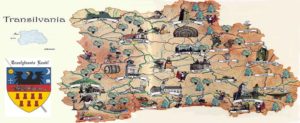
Central Region 7 with the 4 counties that formed the Principality of Transylvania Medieval (Alba, Brasov, Bistrita Nasaud, Cluj, Covasna, Harghita, Hunedoara, Mures, Salaj, Sibiu) has a significant tourism potential and diversified, with several subdomains that enjoys an obvious advantage: mountain tourism, spa tourism, cultural tourism, historical tourism, rural tourism and agrotourism. Accommodation capacity in rural areas in the 10 counties stands at over 55% of the total number of accommodation in Romania.
Romanian tourism continues to grow, according to the latest data published by the National Institute of Statistics. In 2024, the number of arrivals in tourist reception structures reached 14.2 million, registering an increase of 4.5% compared to the previous year. Also, the total number of overnight stays was 30.1 million, 3.5% higher than in 2023. The contributions of the tourism sector to Romania’s GDP have fluctuated in a similar rhythm to tourism expenditure. Figure 5 below shows that tourism and travel24 (including international and domestic tourism) accounted for 6% of Romania’s total GDP in 2019, before declining to 3.5% in 2020 and recovering slightly to 3.8% in 2021. The tourism sector’s share of GDP in Romania is expected to return to its 2019 status of 6% by 2025 (Statista 2022).
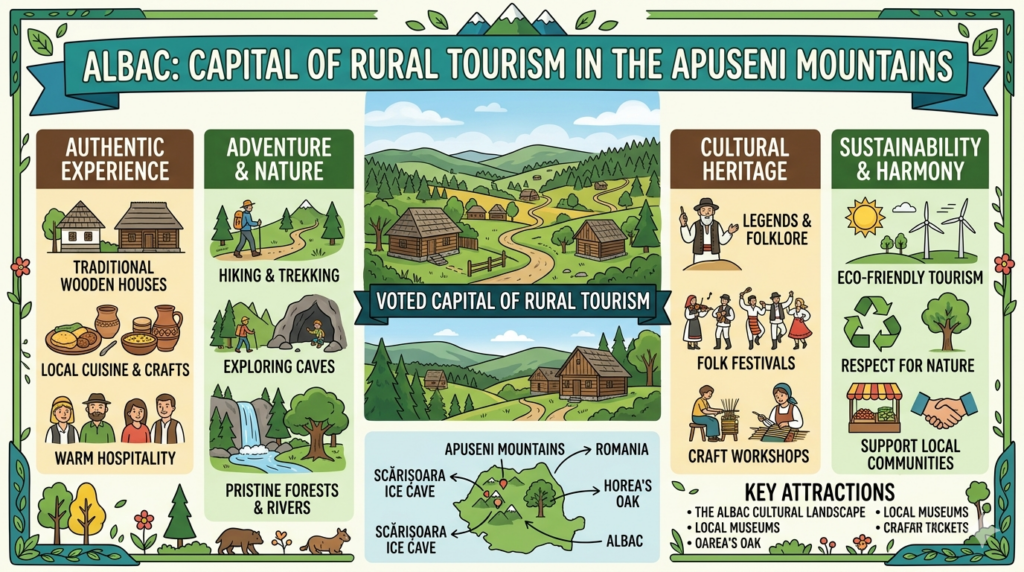
Initially ANTREC Alba Branch located in Albac, Alba Transilvania ANTREC NGO today is one of the most important promoter of tourism in Transylvania. ANTREC Alba Branch initiated and promoted the National Rural Tourism Fair in Albac since 2005. Combining rustic charm and traditions with the natural attractions, agro-tourism is one of the forms of tourism that has seen a remarkable development after 1997 by ANTREC Alba Transylvania – renamed, being well represented in the Apuseni Mountains – Aries Valley High – Albac, Garda de Sus, Scarisoara, Vadul Motilor, Bistra and Sălciua in Trascău Valley Aiudului – Rimetea commune and village Colţeşti – Europa Nostra 1999 keys Aiudului – village springs and Vălişoara in Sebeş Mountains chapel , Loman, Şugag and Heaven’s Gate.
Developing a modern tourist industry, which uses an insufficiently exploited workforce and a great tourism potential in Medieval Transylvania counties, requires enhanced cooperation between NGOs, SMEs, local universities, media outlets etc.
The proposed formula for this purpose ANTREC Alba Transilvania is to establish a CLUSTER for the cultural – initiated in 2014, historical and religious tourism, rural tourism, agritourism and related services. Such CLUSTER will coagulate interests of much of medieval Transylvania, confirming the secular tradition of Alba Iulia major center for the development of Romania.
The association will operate on the basis of truth, courage, determination, loyalty, balance and willingness expressed by members and supporters in all their actions.